
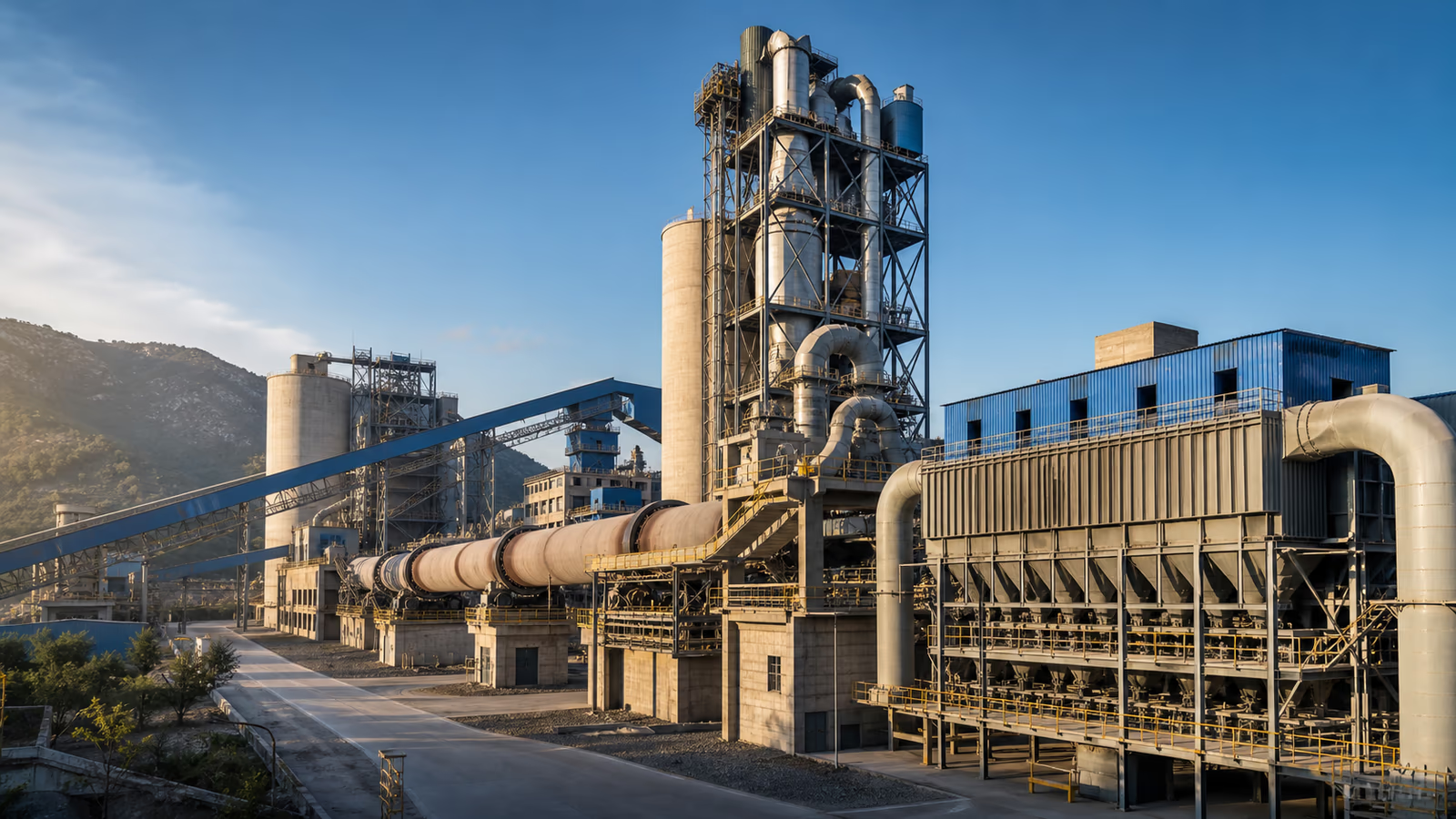
Why Industrial Kilns Are a Priority for Energy Improvement

Technical Articles

How to Investigate Heat Loss in Industrial Kilns

Industrial kiln heat loss should be investigated as a system of connected heat paths rather than judged from one hot surface. This guide explains how to establish a repeatable operating baseline, map the kiln shell and its details, distinguish process effects from insulation defects, and turn field evidence into a controlled improvement brief.

Define the kiln and operating baseline

Start by defining which equipment boundary is under review: the rotating shell, stationary hood, transition duct, support zone or an adjoining process section. Record whether the observation was made during stable production, load change, startup, shutdown or maintenance, because those states cannot be compared as though they were equivalent.

The baseline should connect operating context with the exact inspection position. A surface-temperature image is more useful when it is tied to shell location, process direction, surrounding conditions and the status of the lining or insulation beneath that position.

Mark interfaces before interpreting hot or cool zones. Seals, support structures, access doors, penetrations and changes in lining construction can create legitimate temperature differences or reveal local discontinuities.

Repeat observations under comparable operation whenever possible. A transient reading can identify where to investigate, but it should not become the sole basis for an energy or material decision.

Map the main heat-loss paths

Review the kiln circumferentially and along its process direction. Look for isolated hot spots, continuous bands, repeated patterns near structural details and changes that align with repaired or differently constructed areas.

  • Record the clock position and longitudinal reference for each observation.
  • Distinguish an isolated defect from a repeated band or broad temperature gradient.
  • Compare the same location at more than one operating point when access allows.

Supports, brackets, doors, instrument penetrations and removable sections interrupt otherwise continuous insulation. Treat each interface as its own detail rather than averaging it into a large shell area.

Separate process causes from insulation defects

A high external reading may reflect internal process distribution, lining wear, air leakage, a changed production condition or an insulation discontinuity. Review process observations, maintenance history and the physical condition together before assigning a cause.

Where internal lining condition is uncertain, thermal evidence can guide the inspection location but cannot determine remaining lining thickness or structural fitness on its own.

Build a repeatable field-investigation record

Use a consistent location grid, image naming convention and observation form. Include visible condition, accessibility, adjacent joints, weather, operating state and any recent repair so a later survey can return to the same point.

  • Define the survey boundary and process direction.
  • Capture overview and detail images from known positions.
  • Record instrument settings and relevant field constraints.
  • Separate measured observations from interpretation.
  • List areas that require shutdown access or internal confirmation.

Translate findings into an improvement brief

The brief should identify the heat path to be controlled, the substrate and geometry, access restrictions, maintainable interfaces and how the result will be inspected. It should also state which process or structural defects must be corrected before a thermal layer is considered.

A trial area can be used to confirm preparation, detailing and inspection methods. Any broader performance assessment needs a defined operating baseline and measurement boundary rather than an isolated before-and-after photograph.

Limits of surface-temperature evidence

Surface temperature is affected by emissivity, viewing angle, air movement, surrounding radiation and operating stability. It does not by itself establish heat-flow rate, energy savings, internal lining condition or the service life of a proposed system.

Related technical pathways

Project takeaway

Need technical documents or project guidance?

Send the operating condition and the document or application question you need reviewed.

Request technical support